Showing posts with label Maths. Show all posts

Monday, December 1, 2025

A startup story

Here is a story from the past startup times. It's a mixture of maths and technology, the kind of things I enjoy, as an applied mathematician by education.

Sometime in 2018, I was involved in an R&D project to detect periodic events. I will skip most of the technical parts, those curious can find the entire presentation here. The presentation ends with ...

... and this is the focus of this little post.

The preable of the story is that the VP of Engineering, a lot earlier before the start of this project, "swore" that they will buy champaign to the entire Data Science Team if we end up using Fourier Analysis for whatever purposes. Was it for fun or they were envisioning this project coming - I have no idea.

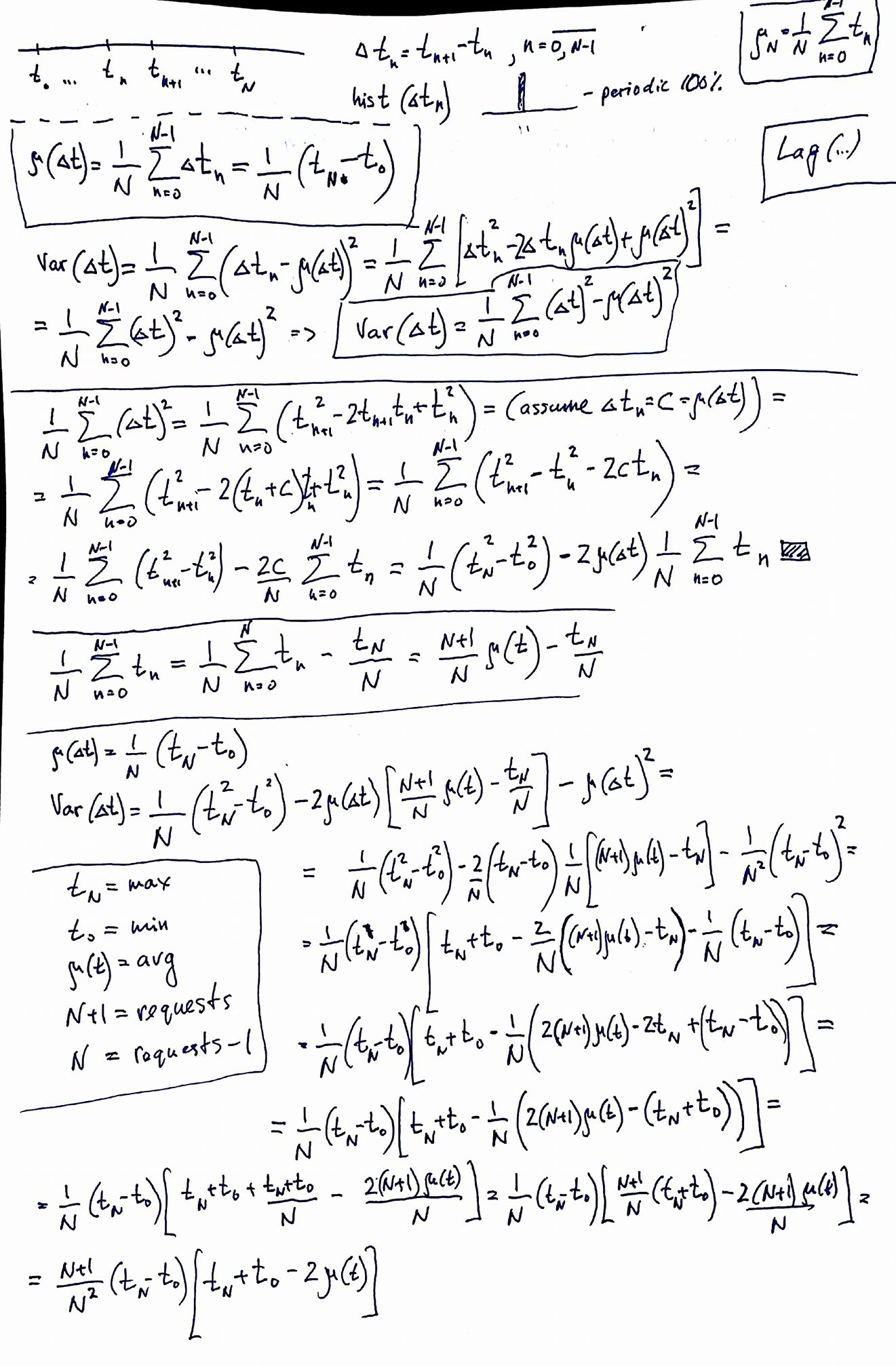
But, the team started "assessing the field". I started looking at a simplified unimodal model. After "doodling" for a couple of hours on a one A4 size page ...

... I came with some "expressions" allowing querying the database for periodic events using ... plain SQL! Amazon Redshift was returning results within 2 minutes. I still remember our CTO saying: "You nailed it!".

However, if you check the presentation, there is no Fourier Analysis there. It's just a simple application of the basic stats, limited to the unimodal model. It was enough though to trigger the further research and this simple model was used as a benchmark.

The team, eventually, started looking for multimodal techniques and Fourier Analyses (on terabytes of data!!!) ... and the team recalled the earlier "promise" from our VP of Engineering. We definitely had a party, I don't remember the champaign though ...

Sunday, April 7, 2024

A property of the Prime Counting function

While addressing this question on MSE the following inequality was revealed, concerning the Prime Counting function ...

For $\forall x,y$ such that $60184\le x< y$ we have: $$\frac{x}{\pi(x)} < \frac{y}{\pi(y)} + 1$$

Monday, April 12, 2021

Golden ratio, Fibonacci numbers and ... another sequence

Over the last weekend, another question was asked and later disappeared on/from Math StakExchange. The sequence, from that question, is too nice to "let it go", thus, copy/pasting my answer here.

Let's define the following sequence $$a(n)=\left\lfloor n\cdot\phi + \frac{1}{2}\right\rfloor$$ where $\phi$ is the golden ratio. Is there a closed form for the following sequence $$a^{\circ k}(n)=\underbrace{a(((...a(n)...)))}_{k \text{ times}}$$?

Calculating a few values of the sequence reveals that this is the A007067, with the property that $$a(a(n))=a(n)+n \tag{1}$$ a result proved in 2006. Let's show it ...


Proposition 1. $\left\lfloor \frac{a(n)}{\phi} + \frac{1}{2}\right\rfloor=n$

Given $x-1 < \lfloor x\rfloor \leq x$, we have $$n\phi - \frac{1}{2} < a(n)\leq n\phi + \frac{1}{2} \iff \\ n-\frac{1}{2\phi} < \frac{a(n)}{\phi}\leq n+\frac{1}{2\phi} \iff \\ n+\frac{1}{2}-\frac{1}{2\phi} < \frac{a(n)}{\phi}+\frac{1}{2}\leq n+\frac{1}{2}+\frac{1}{2\phi}$$

Given $1+\frac{1}{\phi}=\phi$ and $\frac{1}{2}-\frac{1}{2\phi} > 0$, then $$n < n+\frac{1}{2}-\frac{1}{2\phi} < \frac{a(n)}{\phi}+\frac{1}{2}\leq n+\frac{\phi}{2} < n+1$$

or $$n < \frac{a(n)}{\phi}+\frac{1}{2} < n+1 \Rightarrow \left\lfloor \frac{a(n)}{\phi} + \frac{1}{2}\right\rfloor=n$$


Proposition 2. $a(a(n))=a(n)+n$.

Obviously $a(n)\in\mathbb{N}$, then $$a(a(n))= \left\lfloor a(n)\cdot\phi + \frac{1}{2}\right\rfloor= \left\lfloor a(n)\cdot\left(1+\frac{1}{\phi}\right) + \frac{1}{2}\right\rfloor=\\ a(n)+\left\lfloor \frac{a(n)}{\phi} + \frac{1}{2}\right\rfloor = ...$$

applying Proposition 1 $$...= a(n)+n$$


Now back to the original question, a few observations, using $(1)$ $$a^{\circ 2}(n)=a(a(n))=F_2\cdot a(n) + F_1\cdot n$$ $$a^{\circ 3}(n)=a(a(\color{red}{a(n)}))=a(\color{red}{a(n)})+\color{red}{a(n)}=\\ 2\cdot a(n)+n=F_3\cdot a(n) + F_2\cdot n$$ $$a^{\circ 4}(n)=a(a(a(\color{blue}{a(n)})))=2\cdot a(\color{blue}{a(n)})+\color{blue}{a(n)}=\\ 3\cdot a(n)+2n=F_4\cdot a(n) + F_3\cdot n$$

It's easy to see, by induction, this is $$a^{\circ k}(n)=F_k\cdot a(n) + F_{k-1}\cdot n \tag{2}$$

because $$a^{\circ (k+1)}(n)=a^{\circ k}(a(n))=F_k\cdot a(a(n)) + F_{k-1}\cdot a(n)=\\ (F_k+F_{k-1})\cdot a(n) + F_{k}\cdot n=F_{k+1}\cdot a(n) + F_{k}\cdot n$$

Friday, November 6, 2020

An interesting trigonometric identity

Questions follow a complex life cycle on Math StackExchange. Some questions are deleted, because they don't meet the community standards. Nonetheless, some of those deleted questions are interesting and non-trivial. In this post, I will cover one of those questions (you may not be able to see it, without sufficient privilege). I spent a few good hours to spot the pattern, so it won't feel like I wasted that time :) ... and you might like the question as well.

Is it true that $$\prod\limits_{k=1}^{2^{1999}}\left(4\sin^2\left(\frac {k\pi}{2^{2000}} \right)-3\right)=-1$$?

It seems so. Given this and this identities:$$\color{red}{\prod\limits_{k=1}^{2^{1999}}\left(4\sin^2\left(\frac {k\pi}{2^{2000}} \right)-3\right)}= \prod\limits_{k=1}^{2^{1999}} \left(\left(2-2\cos{\frac{k\pi}{2^{1999}}} \right)-3\right)=\\ \prod\limits_{k=1}^{2^{1999}} \left(-1-2\cos{\frac{k\pi}{2^{1999}}} \right)= \prod\limits_{k=1}^{2^{1999}} \left(1+2\cos{\frac{k\pi}{2^{1999}}} \right)=\\ -\prod\limits_{k=1}^{2^{1999}-1} \left(1+2\cos{\frac{k\pi}{2^{1999}}} \right)=\\ -\prod\limits_{k=1}^{2^{1998}-1} \left(1+2\cos{\frac{k\pi}{2^{1999}}} \right) \cdot 1 \cdot \prod\limits_{k=2^{1998}+1}^{2^{1999}-1} \left(1+2\cos{\frac{k\pi}{2^{1999}}} \right)=\\ -\prod\limits_{k=1}^{2^{1998}-1} \left(1+2\cos{\frac{k\pi}{2^{1999}}} \right) \cdot\prod\limits_{k=1}^{2^{1998}-1} \left(1+2\cos{\frac{\left(2^{1998}+k\right)\pi}{2^{1999}}} \right)=\\ -\prod\limits_{k=1}^{2^{1998}-1} \left(1+2\cos{\frac{k\pi}{2^{1999}}} \right) \cdot\prod\limits_{k=1}^{2^{1998}-1} \left(1+2\cos{\left(\frac{\pi}{2}+\frac{k\pi}{2^{1999}}\right)} \right)=\\ -\prod\limits_{k=1}^{2^{1998}-1} \left(1+2\cos{\frac{k\pi}{2^{1999}}} \right) \cdot\prod\limits_{k=1}^{2^{1998}-1} \left(1-2\cos{\left(\frac{\pi}{2}-\frac{k\pi}{2^{1999}}\right)} \right)=\\ -\prod\limits_{k=1}^{2^{1998}-1} \left(1+2\cos{\frac{k\pi}{2^{1999}}} \right) \cdot\prod\limits_{k=1}^{2^{1998}-1} \left(1-2\cos{\frac{\left(2^{1998}-k\right)\pi}{2^{1999}}} \right)=\\ -\prod\limits_{k=1}^{2^{1998}-1} \left(1+2\cos{\frac{k\pi}{2^{1999}}} \right) \cdot\prod\limits_{k=1}^{2^{1998}-1} \left(1-2\cos{\frac{k\pi}{2^{1999}}} \right)=\\ -\prod\limits_{k=1}^{2^{1998}-1} \left(1-4\cos^2{\frac{k\pi}{2^{1999}}} \right)= -\prod\limits_{k=1}^{2^{1998}} \left(1-4\cos^2{\frac{k\pi}{2^{1999}}} \right)=\\ -\prod\limits_{k=1}^{2^{1998}} \left(1-4\left(1-\sin^2{\frac{k\pi}{2^{1999}}} \right)\right)= -\color{red}{\prod\limits_{k=1}^{2^{1998}} \left(4\sin^2{\frac{k\pi}{2^{1999}}}-3\right)}$$

By induction: $$\prod\limits_{k=1}^{2^{1999}}\left(4\sin^2\left(\frac {k\pi}{2^{2000}} \right)-3\right)= -\prod\limits_{k=1}^{2^{1998}} \left(4\sin^2{\frac{k\pi}{2^{1999}}}-3\right)=\\ (-1)^2 \prod\limits_{k=1}^{2^{1997}} \left(4\sin^2{\frac{k\pi}{2^{1998}}}-3\right)=\\ (-1)^n \prod\limits_{k=1}^{2^{1999-n}} \left(4\sin^2{\frac{k\pi}{2^{1999-n+1}}}-3\right)=\\ (-1)^{1999} \prod\limits_{k=1}^{1} \left(4\sin^2{\frac{k\pi}{2}}-3\right)=(-1)^{1999}$$

Wednesday, July 3, 2019

401 and/or 403 and a short story of secure RESTful

The problem of what HTTP codes to use inevitably comes when designing RESTful services. There is a bit of subtlety, however, with regards to the 401 and 403 status codes. Here and there you will read advices suggesting to use:

  • 401 for when an access token isn’t provided, or is invalid.
  • 403 for when an access token is valid, but requires more privileges.
and people will follow these advices without considering the security part of the problem.

And the problem is that such an implementation can leak sensitive information. Here is my reply to the above mentioned article. In cryptography this is known as oracle and can lead to pretty serious attacks.

If the attacker sees a 403 status code, after a huge array of failed attempts with 401, this means that whatever the attacker tried passed the authentication phase, but failed the authorisation. Bingo, they just figured out a valid set of credentials (or tokens or ...) and your system said that in "clear text". It is similar to the "Username or password invalid" best practices (and don't read things like this!).

How to avoid the problem? Stick with one status code (e.g. 403) for both cases (failed authentication and failed authorisation), avoid being too user (or client) friendly. You can log the incident and return a unique request ID to the client. If a genuine client reports the problem, that request ID should help finding more details in logs. And of course track/monitor all the authentication/authorisation failures for anomaly detection purposes.

Now the fun part, all of the above as a mathematical proof. Let's assume a system where the maximum number of credentials possible is $N$, has $M$ registered users and $K$ of those users have access to a specific resource that the attacker tries to brute-force, $N>M\geq K$. Let's consider the following propositions/events:

  • $A$ - guess a credential by accessing the given resource.
  • $B$ - The system is designed to return: HTTP 200 for valid credentials with access to the resource, HTTP 403 for valid credentials with no access to the resource, HTTP 401 for invalid credentials. For simplicity, we can say $B=\{200\}\bigcup \{403\}\bigcup \{401\}$.
  • $C$ - The system is designed to return: HTTP 200 for valid credentials with access to the resource, HTTP 403 for valid credentials with no access to the resource or invalid credentials. Or $C=\{200\}\bigcup \{403\}$

In other words:

  • Cardinality of $A$ givnen $B$ is: $K$ possible cases of HTTP 200, plus $M-K$ possible cases of HTTP 403. Grand total is $M$.
  • Cardinality of $A$ givnen $C$ is: $K$ possible cases of HTTP 200, which is also the grand total.

Now let's compute probabilities: $$P(A \mid B)=\frac{M}{N}$$ and $$P(A \mid C)=\frac{K}{N}$$ Obviously (because $M \geq K$) $$P(A \mid B) \geq P(A \mid C)$$ which means, a system designed like $B$ gives greater chances to the attacker to guess credentials. Obviously, it doesn't matter when all the registered users have access to the resource (i.e. $K=M$). End of discussion!

P.S. The way I computed probabilities may look a bit superficial, here is another way using total probabilities or $$P(A\mid B) = \frac{P(A \cap B)}{P(B)}=\sum\limits_{C_n} \frac{P(A \cap B \cap C_n)}{P(B)}=\\ \sum\limits_{C_n} \frac{P(A \cap B \cap C_n)}{P(B\cap C_n)}\cdot \frac{P(B\cap C_n)}{P(B)}=\\ \sum\limits_{C_n} P(A \mid B \cap C_n)\cdot P(C_n\mid B)$$ Then:

  • $$P(A\mid B)=P(A\mid B \cap \{200\})\cdot P(\{200\}\mid B)+\\ P(A\mid B \cap \{403\})\cdot P(\{403\}\mid B)+\\ P(A\mid B \cap \{401\})\cdot P(\{401\}\mid B)=\\ P(A\mid \{200\})\cdot P(\{200\}\mid B)+ P(A\mid \{403\})\cdot P(\{403\}\mid B)+\\ P(A\mid \{401\})\cdot P(\{401\}\mid B)=\\ 1\cdot P(\{200\}\mid B)+ 1\cdot P(\{403\}\mid B)+ 0\cdot P(\{401\}\mid B)=\\ \frac{K}{N}+\frac{M-K}{N}=\frac{M}{N} $$
  • $$P(A\mid C)=P(A\mid C \cap \{200\})\cdot P(\{200\}\mid C)+\\ P(A\mid C \cap \{403\})\cdot P(\{403\}\mid C)=\\ P(A\mid \{200\})\cdot P(\{200\}\mid C)+ P(A\mid \{403\})\cdot P(\{403\}\mid C)=\\ 1\cdot P(\{200\}\mid C)+ 0\cdot P(\{403\}\mid C)=\frac{K}{N}$$

Saturday, August 12, 2017

The matter of squares and rectangles

Being in Oxford and not dedicating some time to browse the local book shops is, imho, a crime. In one of my recent visits I found this recreational maths book "Mathematics and Chess" (Dover Publications, 1997) by Miodrag Petković. The very first problem in this book is:

Prove that the total number of rectangles that can be found on a generalized $n \times n$ board is a perfect square of a natural number.

You know, those squares from job interviews and puzzles? Yes, those! So this almost popular matter needs to be sorted out. I will skip the proofs, since almost everything is on Wikipedia these days and the proofs aren't complicated, simple applications of induction. The formula for rectangles is simply beautiful: $$\sum_{k=1}^{n} k^3=\left ( \sum_{k=1}^{n} k \right )^2=\left [ \frac{n(n+1)}{2} \right ]^2$$ Squares and cubes, amazing, isn't it?

While the formula for squares is simply: $$\sum_{k=1}^{n} k^2=\frac{n(n+1)(2n+1)}{6}$$

Saturday, May 28, 2016

Just a beautiful inequality

Last week, Worldwide Center of Mathematics posted this problem on their Facebook page. So, I felt challenged. The solution turned to be quite simple, but that's not the point. The point is, this inequality simply looks beautiful.

Long story short, the task is to prove the following $$e^{\pi} > \pi^{e}$$

I will use few tricks, in form of this well known inequality $$x-1 \geq \ln(x), \forall x >0$$ and the fact that $x=\ln(\pi) > \ln(e)=1$. In fact this inequality is strict for $\forall x > 1$

As a result $$\ln(\pi)-1 > \ln(\ln(\pi)) \Leftrightarrow \ln(\pi) > 1+\ln(\ln(\pi)) $$

Luckily, exponential function $f(x)=e^x$ is strictly ascending, thus: $$e^{\ln(\pi)} > e^{1+\ln(\ln(\pi))} \Leftrightarrow \pi > e \cdot \ln(\pi) \Leftrightarrow \pi > \ln(\pi^e)$$

Using the exponential function trick again $$e^{\pi} > e^{\ln(\pi^e)} \Leftrightarrow e^{\pi} > \pi^e$$

Sunday, June 23, 2013

Another number theory problem

This is the second post dedicated to the problems set posted on "Math, Math Education, Math Culture" LinkedIn group. Here is the original LinkedId discussion, again ... if you happen to have a LinkedIn account. Here is the problem:

Prove that the sequence a1=1, a2=11, a3=111, a4=1111,... contains an infinite sub-sequence whose terms are pairwise relatively prime.

Few observations first of all, without proving them as it should be fairly trivial, e.g. using induction: $$a_{m+n}=a_{m}\cdot 10^{n}+a_{n}$$

From the above: $$a_{m\cdot n} = a_{(m - 1)\cdot n}\cdot 10^{n} + a_{n} = a_{n}\cdot 10^{n\cdot (m-1)} + a_{n}\cdot 10^{n\cdot (m-2)} + ... + a_{n}\cdot 10^{n} + a_{n} $$

So if $a_{n}$ is divisible by $t\in \mathbb{N}, t>1$ then $a_{m\cdot n}$ is also divisible by $t$ (1).

Now, let's consider the sub-sequence $\left \{ a_{p_{k}} \right \}_{k=1}^{\infty } \subset \left \{ a_{n} \right \}_{n=1}^{\infty }$, where $p_{k}$- k-th prime. I state that this sub-sequence satisfies the condition of the problem. Let's prove it by contradiction.

I.e. let's assume there $\exists k \neq m$ such that $\gcd\left ( a_{p_{m}}, a_{p_{k}}\right )= d > 1$. Because $\gcd\left ( p_{m}, p_{k}\right )= 1$ (i.e. both are prime numbers), then, by applying Bezout's theorem (or lemma), there $\exists r,s\in \mathbb{Z}$ such that: $$r\cdot p_{m} + s\cdot p_{k}=1$$

Both $r,s$ can't be negative and positive as the same time, so we can rewrite it this way: $$r\cdot p_{m} = s\cdot p_{k} + 1$$ assuming both $r$ and $s$ are positive this time.

Because we assumed $\gcd\left ( a_{p_{m}}, a_{p_{k}}\right )= d > 1$, then $d$ should also divide both $a_{r\cdot p_{m}}, a_{s\cdot p_{k}}$ (using (1) proved above). But $$a_{r\cdot p_{m}} = a_{s\cdot p_{k}+1} = a_{s\cdot p_{k}} \cdot 10 + a_{1}$$ which means $d>1$ also divides $a_{1}=1$. Contradiction.

As a result $\forall k \neq m$, $\gcd\left ( a_{p_{m}}, a_{p_{k}}\right )= 1$.

Saturday, June 8, 2013

Another probability problem

An interesting set of problems was posted on "Math, Math Education, Math Culture" LinkedIn group few weeks ago. I engaged myself in addressing few of them, so I will be posting my solutions in the next few posts. Just to clarify this from the beginning, interesting doesn't necessarily mean difficult. This particular post is dedicated to the probability problem and here is the original LinkedId discussion, if you happen to have a LinkedIn account. Otherwise, continue reading this post. Here is the problem ...

We have n urns, each of these urns contains A white balls and B black balls. We assume a ball from the first urn is randomly picked and then placed into the second urn, then another ball from the second urn is randomly picked and then placed into the third urn, and so on, until a ball from the last urn is finally randomly picked. If this last ball is white, what probability has this fact?

One way to attack the problem is to use total probability (Wikipedia is probably more descriptive on this topic).

Let's define the following two events:
- Wi - white ball is picked from i-th urn
- Bi - black ball is picked from i-th urn.
It is worth noting that $P\left ( W_{i} \right )+P\left ( B_{i} \right )=1$.

Now, applying total probability we have: $$P\left ( W_{n} \right ) = P\left ( W_{n} | W_{n-1} \right )\cdot P\left ( W_{n-1} \right )+P\left ( W_{n} | B_{n-1} \right )\cdot P\left ( B_{n-1} \right )$$ Where:
- $P\left ( W_{n} | W_{n-1} \right )=\frac{A+1}{A+B+1}$ - translated as "probability to pick a white ball from n-th urn, knowing that a white ball was picked from n-1-th urn"
- $P\left ( W_{n} | B_{n-1} \right )=\frac{A}{A+B+1}$ - translated as "probability to pick a white ball from n-th urn, knowing that a black ball was picked from n-1-th urn".

Putting all these together, we obtain: $$P\left ( W_{n} \right )= P\left ( W_{n-1} \right )\cdot \frac{1}{A+B+1}+\frac{A}{A+B+1}$$ Or, if we note $k= \frac{1}{A+B+1}$, then: $$P\left ( W_{n} \right )= P\left ( W_{n-1} \right )\cdot k+A\cdot k$$

Continuing doing this recursively, we obtain: $$P\left ( W_{n} \right )= P\left ( W_{1} \right )\cdot k^{n-1} + A\cdot \left ( k^{n-1}+k^{n-2}+...+k^{2}+k \right )$$ Where (because W1 relates to the very first urn): $$P\left ( W_{1} \right )=\frac{A}{A+B}=A\cdot \frac{k}{1-k}$$

Finally: $$P\left ( W_{n} \right )=A\cdot \frac{k^{n}}{1-k}+A\cdot \frac{k^{n}-k}{k-1}=\frac{A}{A+B}$$

Which means, the trick with picking randomly a ball and moving it to the next urn has no effect on the final probability. Interesting, isn't it?

Sunday, May 26, 2013

Tackling Andrica's conjecture. Part 3

Here is an interesting, but slightly detached from the previous two articles, result. Let's look at the following two sequences: $$a_{n}=\sqrt{p_{n+1}} - \sqrt{p_{n}}$$ $$b_{n}=\ln\left ( \frac{1+\sqrt{p_{n+1}}}{1+\sqrt{p_{n}}} \right )^{1+\sqrt{p_{n+1}}}$$

Here is a short Python code to visualise the sequences.

And here is how both sequences look like ($a_{n}$ the first and $b_{n}$ the second): Quite asymptotic, aren't they? Indeed they are ...

Lemma 3. $$\sqrt{p_{n+1}} - \sqrt{p_{n}} \leq \ln\left ( \frac{1+\sqrt{p_{n+1}}}{1+\sqrt{p_{n}}} \right )^{1+\sqrt{p_{n+1}}} \leq \left ( \frac{1+\sqrt{p_{n+1}}}{1+\sqrt{p_{n}}} \right )\cdot \left ( \sqrt{p_{n+1}} - \sqrt{p_{n}} \right )$$

Let's look at this function $f_{6}(x)=\frac{\sqrt{p_{n+1}}}{1+x\cdot \sqrt{p_{n+1}}}$. Obviously, ${\ln\left ( 1+x\cdot \sqrt{p_{n+1}} \right )}'=f_{6}(x)$. As a result $$\int\limits_{\sqrt{\frac{p_{n}}{p_{n+1}}}}^{1} f_{6}\left ( x \right )dx = \ln\left ( 1+x\cdot \sqrt{p_{n+1}} \right )|_{\sqrt{\frac{p_{n}}{p_{n+1}}}}^{1}=\ln\left ( \frac{1+\sqrt{p_{n+1}}}{1+\sqrt{p_{n}}} \right )$$

According to Mean Value Theorem, $\exists \mu \in \left (\sqrt{\frac{p_{n}}{p_{n+1}}} ,1 \right )$ such that: $$\int\limits_{\sqrt{\frac{p_{n}}{p_{n+1}}}}^{1} f_{6}\left ( x \right )dx = f_{6}\left ( \mu \right )\cdot \left ( 1- \sqrt{\frac{p_{n}}{p_{n+1}}} \right )$$

Putting all together: $$\ln\left ( \frac{1+\sqrt{p_{n+1}}}{1+\sqrt{p_{n}}} \right ) = \frac{\sqrt{p_{n+1}}-\sqrt{p_{n}}}{1+\mu \cdot \sqrt{p_{n+1}}}$$

Because $$\sqrt{\frac{p_{n}}{p_{n+1}}}< \mu < 1 \Rightarrow 1+\sqrt{p_{n}}< 1+\mu \cdot \sqrt{p_{n+1}} < 1+\sqrt{p_{n+1}} $$

And we get $$\frac{\sqrt{p_{n+1}}-\sqrt{p_{n}}}{1+\sqrt{p_{n+1}}}\leq \ln\left ( \frac{1+\sqrt{p_{n+1}}}{1+\sqrt{p_{n}}} \right )\leq \frac{\sqrt{p_{n+1}}-\sqrt{p_{n}}}{1+\sqrt{p_{n}}}$$ which proves this lemma.

Noting $\Delta_{n}=\sqrt{p_{n+1}}-\sqrt{p_{n}}$, this becomes: $$\frac{\Delta_{n}}{1+\sqrt{p_{n+1}}}\leq \ln\left ( 1 + \frac{\Delta_{n}}{1+\sqrt{p_{n}}} \right )\leq \frac{\Delta_{n}}{1+\sqrt{p_{n}}}$$ or $$\frac{1+\sqrt{p_{n}}}{1+\sqrt{p_{n+1}}}\leq \ln\left ( 1 + \frac{\Delta_{n}}{1+\sqrt{p_{n}}} \right )^{\frac{1+\sqrt{p_{n}}}{\Delta_{n}}}\leq 1$$

Is this result of any use? I don't know yet, but it looks like: $$\left ( 1 + \frac{\Delta_{n}}{1+\sqrt{p_{n}}} \right )^{\frac{1+\sqrt{p_{n}}}{\Delta_{n}}} \rightarrow e, n \to \infty$$ using this result.

Sunday, November 11, 2012

Tackling Andrica's conjecture. Part 2

With the previous post, I stopped at the argument that $f_{4}(x)=\pi (x) - \sqrt{x}$ seems to be ascending for prime arguments. Apparently, this is a necessary and sufficient condition, i.e.:
Lemma 1. Andrica's conjecture is true iff function $f_{4}(x)=\pi (x) - \sqrt{x}$ is strictly ascending ($x < y \Rightarrow f(x) < f(y)$) for prime arguments.
The proof is given in the following discussion with the math.stackexchange.com community.
It is worth mentioning that $f_{4}(x)$ is descending in between prime numbers. For example for $\forall x\in \left ( p_{n}, p_{n+1} \right )$, $f_{4}(x)=n - \sqrt{x}$ and ${f_{4}}'(x)=-\frac{1}{2\cdot \sqrt{x}} < 0$.
In fact the purpose of the discussion was to prove that $$\sqrt{p_{n}} < n$$ which turns to be true for $\forall n \geq 2$, using Rosser's theorem.
Interesting result, out of this inequality, is that $$\sqrt{p_{n}} - \sqrt{p_{1}} < n-1$$ because $\sqrt{p_{1}}=\sqrt{2} > 1$. However, $$\sum_{k=2}^{n}\left ( \sqrt{p_{k}} - \sqrt{p_{k-1}} \right )=\sqrt{p_{n}} - \sqrt{p_{1}} < n-1$$ and as a result $$\frac{1}{n-1}\cdot \sum_{k=2}^{n}\left ( \sqrt{p_{k}} - \sqrt{p_{k-1}} \right ) < 1$$ or, in other words, on average Andrica's conjecture seems to be true.
But, leaving the statistical argument aside, how do we prove that $f_{4}(x)$ is ascending for prime arguments?
I don't have the answer yet, but here is where I stuck ...
Let's have a look at the following function $$f_{5}(x)=1 - \sqrt{p_{n+1} + x} + \sqrt{p_{n} + x}$$ This function is ascending $\forall x \geq -p_{n}$ $${f_{5}(x)}'= -\frac{1}{2\cdot \sqrt{p_{n+1} + x}} + \frac{1}{2\cdot \sqrt{p_{n} + x}} > 0$$ because $\sqrt{p_{n+1} + x} > \sqrt{p_{n} + x}$, for $\forall x \geq -p_{n}$.
This function also has a zero, $1=\sqrt{p_{n+1} + x} - \sqrt{p_{n} + x} \Leftrightarrow $ $$1 = p_{n+1}+p_{n} +2\cdot x -2\cdot \sqrt{(p_{n+1} + x)\cdot (p_{n} + x)} \Leftrightarrow $$ $$2\cdot \sqrt{(p_{n+1} + x)\cdot (p_{n} + x)}=p_{n+1}+p_{n} +2\cdot x - 1 \Leftrightarrow $$ $$4\cdot (p_{n+1} + x)\cdot (p_{n} + x)=p_{n+1}^{2}+p_{n}^{2}+4\cdot x^{2}+1+2\cdot p_{n+1}\cdot p_{n}+$$ $$+4\cdot p_{n+1}\cdot x-2\cdot p_{n+1}+4\cdot p_{n}\cdot x-2\cdot p_{n}-4\cdot x \Leftrightarrow $$ jumping ahead $$2\cdot p_{n+1}\cdot p_{n}=p_{n+1}^{2}+p_{n}^{2}+1-2\cdot p_{n+1}-2\cdot p_{n}-4\cdot x \Leftrightarrow $$ $$4\cdot x=(p_{n+1}-p_{n})^{2}-2\cdot (p_{n+1}+p_{n})+1=(p_{n+1}-p_{n}-1)^{2}-4\cdot p_{n}$$ as a result $$x_{0}=\left( \frac{p_{n+1}-p_{n}-1}{2} \right)^{2}-p_{n}$$ Obviously, $x_{0} > -p_{n}$.
And now:
Lemma 2. $f_{4}(p_{n+1}) > f_{4}(p_{n})$ iff $x_{0} < 0$, where $x_{0}$ is zero of $f_{5}(x)$.
First of all $$x_{0} < 0 \Leftrightarrow p_{n+1}-p_{n} < 2\cdot \sqrt{p_{n}}+1$$
As a result, if $f_{4}(p_{n+1}) > f_{4}(p_{n})$ this is equivalent (from Lemma 1) with $\sqrt{p_{n+1}}-\sqrt{p_{n}} < 1$ (Andrica's inequality for $p_{n}, p_{n+1}$). But then $$p_{n+1} - p_{n}=(\sqrt{p_{n+1}}-\sqrt{p_{n}})\cdot (\sqrt{p_{n+1}}+\sqrt{p_{n}}) < \sqrt{p_{n+1}}+\sqrt{p_{n}}$$ and applying Andrica's inequality again $$p_{n+1} - p_{n} < \sqrt{p_{n}}+1+\sqrt{p_{n}}=2\cdot \sqrt{p_{n}}+1$$ so $x_{0} < 0$.
Now, if $x_{0} < 0$, where we know that $x_{0} > -p_{n}$, and the fact that $f_{5}(x)$ is ascending then we have $$x_{0} < 0 \Rightarrow 0=f_{5}(x_{0}) < f_{5}(0)=1 - \sqrt{p_{n+1}} + \sqrt{p_{n}}$$ or $$\sqrt{p_{n+1}}-\sqrt{p_{n}} < 1$$ and then (Lemma 1) $f_{4}(p_{n+1}) > f_{4}(p_{n})$.
Do we know if $p_{n+1}-p_{n} < 2\cdot \sqrt{p_{n}}+1$ for $\forall n$?
Not yet, but we are close. One result, proved by Martin Huxley, states that $p_{n+1}-p_{n} < p_{n}^{\theta }$ for $\theta > \frac{7}{12}$ and sufficiently large $n$. In our case, $\theta =0.5$
Another result by Baker, Harman and Pintz states that $\theta$ may be taken to be 0.525.

Sunday, September 23, 2012

Tackling Andrica's conjecture. Part 1

Andrica's conjecture is one of those mathematical statements which are extremely easy to formulate, but complicated to prove. In fact it hasn't been proved yet, to be more precise. Here we go, for all consecutive prime numbers $p_{n}$ and $p_{n+1}$, it happens that: $$\sqrt{p_{n+1}} - \sqrt{p_{n}}< 1$$

1. The first attempt

Let's start with an analogy, here is an inequality $p_{n+1} < 2\cdot p_{n}$ which is a direct result from Bertrand's postulate, proved by Chebyshev. As a result of this inequality, we have: $$0 < \ln(p_{n+1}) - \ln(p_{n}) < \ln(2) < 1$$ But what is the relationship between natural logarithm and square root functions?

Well, let's have a look at the following function: $f_{1}(x)=\sqrt{x} - \ln(x)$. First derivative of this function is ${f_{1}}'(x) = \frac{1}{2\cdot \sqrt{x}} - \frac{1}{x}=\frac{1}{x}\cdot \left ( \frac{\sqrt{x}}{2} -1\right )\geq 0$, for $\forall x\geq 4$. This means that $f_{1}(x)$ is ascending for $\forall x\geq 4$. As a result, for $\forall p_{n}\leq p_{n+1}$, $n\geqslant 3$ (because $p_{3}=5$) $\Rightarrow f_{1}(p_{n}) \leq f_{1}(p_{n+1})$ or $$\sqrt{p_{n}} - \ln(p_{n}) \leq \sqrt{p_{n+1}} - \ln(p_{n+1})$$ Finally: $$0< \ln(p_{n+1}) - \ln(p_{n}) \leq \sqrt{p_{n+1}} - \sqrt{p_{n}}, \forall n\geq 3$$ As we can see, the analogy isn't of any use really, though we have a nice inequality.

2. The second attempt

Let's have a look at another function: $f_{2}(x)=\frac{x}{\ln(x)} - \sqrt{x}$. Its first derivative is $${f_{2}}'(x)=\frac{\ln(x)-1}{(\ln(x))^{2}}-\frac{1}{2\cdot \sqrt{x}}=\\ \frac{1}{2\cdot \sqrt{x}\cdot (\ln(x))^{2}}\cdot \left ( 2\cdot \sqrt{x}\cdot \ln(x)-2\cdot \sqrt{x}-(\ln(x))^{2} \right )$$

For the first term we have: $\frac{1}{2\cdot \sqrt{x}\cdot (\ln(x))^{2}}> 0$, for $\forall x> 0$.

Let's check the second term: $\left ( 2\cdot \sqrt{x}\cdot \ln(x)-2\cdot \sqrt{x}-(\ln(x))^{2} \right )=$ $\left (-x+2\cdot \sqrt{x}\cdot \ln(x)-(\ln(x))^{2}-2\cdot \sqrt{x}+x \right )=$ $\left [ -\left ( x-2\cdot \sqrt{x}\cdot \ln(x)+(\ln(x))^{2} \right ) +\left ( 1- 2\cdot \sqrt{x}+x\right )-1\right ]=$ $\left [ \left ( \sqrt{x}-1\right )^{2}-\left ( \sqrt{x}-\ln(x) \right )^{2} -1\right ]$ and we are not done yet. Using $a^{2}-b^{2}=(a-b)\cdot (a+b)$, we have: $\left ( 2\cdot \sqrt{x}\cdot \ln(x)-2\cdot \sqrt{x}-(\ln(x))^{2} \right )=$ $\left [ \left ( \ln(x)-1 \right )\cdot \left ( \sqrt{x}-1+\sqrt{x}-\ln(x) \right )-1 \right ]$.

What we have so far:

  • $\ln(x)-1 \geq 1$, for $\forall x \geq e^{2}$
  • $\sqrt{x}-1 \geq 1$, for $\forall x \geq 4$
  • $\sqrt{x}-\ln(x)>0$, for $\forall x \geq 4$, this is, by the way, $f_{1}(x)$, so $f_{1}(x)\geq f_{1}(4)>0$
Altogether: $\left ( 2\cdot \sqrt{x}\cdot \ln(x)-2\cdot \sqrt{x}-(\ln(x))^{2} \right )\geq 0$, for $\forall x\geq e^{2}$.

This means ${f_{2}}'(x)\geq 0$ and $f_{2}(x)$ is ascending, for $\forall x\geq e^{2}$. As a result, for $\forall p_{n}\leq p_{n+1}$, $n\geqslant 3$ (the cases for $p_{3}=5$, $p_{4}=7$ and $p_{5}=11$ can be verified with a calculator) $\Rightarrow f_{2}(p_{n}) \leq f_{2}(p_{n+1})$ or $$\frac{p_{n}}{\ln(p_{n})} - \sqrt{p_{n}}\leq \frac{p_{n+1}}{\ln(p_{n+1})} - \sqrt{p_{n+1}}$$ Final result is (let's note it as (2)): $$ \sqrt{p_{n+1}}- \sqrt{p_{n}}\leq \frac{p_{n+1}}{\ln(p_{n+1})} - \frac{p_{n}}{\ln(p_{n})}, \forall n\geq 3$$

2.1 A negative result of the second attempt

It is worth mentioning that function $\frac{x}{\ln(x)}$ has a special role in the number theory. According to the Prime Number Theorem: $\displaystyle\smash{\lim_{x \to \infty }}\tfrac{\pi (x)}{x/\ln(x)}=1$, where $\pi (x)$ is the prime counting function.

Obviously, $\displaystyle\smash{\lim_{n \to \infty }}\tfrac{\pi (p_{n})}{p_{n}/\ln(p_{n})}=1$ and $\displaystyle\smash{\lim_{n \to \infty }}\tfrac{\pi (p_{n+1})}{p_{n+1}/\ln(p_{n+1})}=1$ (as sub-sequences).

Also $\pi (p_{n})=n$ and $\pi (p_{n+1})-\pi (p_{n})=1$.

If we put all these together, does it mean that $\displaystyle\smash{\lim_{n \to \infty }} \left ( \frac{p_{n+1}}{\ln(p_{n+1})} - \frac{p_{n}}{\ln(p_{n})} \right )=1$?

Nope, it doesn't, check this link for more details.

2.2 A positive result of the second attempt

According to the following article, in 2005 it was proved that $\displaystyle\smash{\lim_{n \to \infty }}\inf \frac{g_{n}}{\ln(p_{n})}=0$, where $g_{n}=p_{n+1}-p_{n}$ or the n-th gap.

It is also obvious that $\frac{p_{n+1}}{\ln(p_{n+1})} < \frac{p_{n+1}}{\ln(p_{n})}$ (because $p_{n} < p_{n+1}$ and $\ln(p_{n}) < \ln(p_{n+1})$). As a result: $$ \sqrt{p_{n+1}}- \sqrt{p_{n}}\leq \frac{p_{n+1}}{\ln(p_{n+1})} - \frac{p_{n}}{\ln(p_{n})}\leq \frac{g_{n}}{\ln(p_{n})}, \forall n\geq 3$$ Or $$\displaystyle\smash{\lim_{n \to \infty }}inf\left ( \sqrt{p_{n+1}}- \sqrt{p_{n}} \right )=0$$ This means that Andrica's conjecture is true for an infinity pairs of $p_{n}$ and $p_{n+1}$. It doesn't prove the conjecture though, which states "it is true for all $p_{n}$ and $p_{n+1}$"

3. The third attempt

How about the following function $f_{3}(x)=\pi (x) - \frac{x}{\ln(x)}$? Well, for this case I used a little Python program, the code is here. First of all, $f_{3}(23)=1.66463325521 > f_{3}(29)=1.38774807317$. So, $f_{3}(x)$ is not ascending. The general tendency of $f_{3}(x)$ seems to be ascending though, according to this graphic (click to enlarge):

At least, for the areas where the function is ascending for consecutive primes (update the program to plot just plt.plot(x1, y1), i.e. primes and values of the function for the prime arguments), Andrica's conjecture is true, because if $$\pi (p_{n+1}) - \frac{p_{n+1}}{\ln(p_{n+1})} \geq \pi (p_{n}) - \frac{p_{n}}{\ln(p_{n})}$$ then (also consider (2)) $$1=\pi (p_{n+1}) - \pi (p_{n}) \geq \frac{p_{n+1}}{\ln(p_{n+1})} - \frac{p_{n}}{\ln(p_{n})}$$ Still, this is not a proof.

4. What's next?

Well, probably the next logical thing is to analyse the function $f_{4}(x)=\pi (x) - \sqrt{x}$. At least it seems to be ascending for prime arguments.

But the work is still in progress...

Tuesday, May 22, 2012

Factoring big numbers and RSA

Last week I came across this article. It's an interesting report indeed and with this post I will explain what is the implication. But first of all, let's quickly recall what RSA encryption is.

There is a message m which needs to be encrypted. There is a public key (e, n) and a private key (d, n). Message is encrypted in the following way c = me (mod n). Cipher text is decrypted in the following way m = cd (mod n). Puting all these together me⋅d ≡ m (mod n) and if m and n are co-prime then me⋅d-1 ≡ 1 (mod n). n is selected to be a product of two distinct prime numbers n = p⋅q and, according to the Euler's theorem, mφ(n) ≡ 1 mod n. Now e and d (exponents of the public/private keys) are selected so that e⋅d - 1 ≡ 0 (mod φ(n)) or e⋅d - 1 = k⋅φ(n), k - integer.

Because n is a product of really big prime numbers (thus n is a big number itself), then factoring it is a really complicated problem, considering "limited" computational power of the modern computers and the fact that factoring is an exponential (in terms of complexity) problem. As a result, computing φ(n), which in this particular case is φ(n) = (p - 1)⋅(q - 1), is also a complicated problem.

However, computing the greatest common divisor (GCD) isn't a complicated problem. As a result, if two public keys (e1, n1) and (e2, n2) are spotted, so that GCD(n1, n2) > 1, then decoding the relevant messages m1 and m2 becomes and easy task and this is the topic of the article I have mentioned at the top of this post.

Now, let's do a quick test. Imagine the following two public keys and associated cipher texts:

e1 = 65537
n1 = 59271838373237712241010698426785545947980750376894660532845611609385295
     49357464245996603984250810283460055082118943354872215289998388427726673
     74160929852573051680099378617005092405110706474184136037559125038434888
     56979904991517729100725512850421664634705274281314737938901139871448406
     073842088742598680079967
cipher1 = "J\u00c1R\u0090\u00e1\u00f4\u008b5My\u00f8\u00a1\u00f4>\u00a2\u00c3\u0010
           \u00bd\u00eb\u00cc&\u007fb\u001aC$\u001d\u00c5\u00b7\u00cdz\u00b7\u0017
           \u008a#9\u0012\u0089\u00feao\u0019\u009c\u00eb\u00b0>\u0086\u009b
           \u001d3~b0-u\u00fc\u0004!\rc\\\u00cb$\u0091\u009e\u00a1N\u009d2\u00ff
           \u0019\u009a9vH.\u00d5\u00e7m\u00a9m\u00ea^\u00d3T$\u00d7\u00d7\u0011
           \u0081\u00e4B\u009b~\u008c$\u00a6K\u008a\u00dc`\u00b4\u009cu\u00fb\u00c2
           \u0006\u00d1\u00bb\u00b9\u00a0\u008f\u00d2\u00bc\u0002\u00f6#\u001f\u001dM
           \u00bb\u0098\u00f2\u00a0\u009fO\u0080"

e2 = 65537
n2 = 72216220929585874029800250341144628594049328751082632793975238142970345
     80195859400832155769761460789049220801438471143407662437503457520665980
     33488377571129629910281750410842883648532072455460838627134172456428247
     65387577331828704441227356582723560291425753389466410790421096831823015
     438162111864463275922441
cipher2 = ".\u00fd9\u008dc\u00da\u00f9o\u00f5Vl\u00fb\u0087\u00ed\u00d5 \u00ee\u00cf
           \u0097~\u00d8T\u00f9.\u0018\u00b1\u00d5n^\u00a0\rA\u00e0\u001d\u00d5
           \u00c8:D\u00c9\u0014o\u00de\u00dbo\u00f9>)bc'a\u00a2\u008e\u00c1|\u00dd
           \r[q1\u00ac\u000f^\u0082b/A\u0010\u0087\u00ff\u00e4k=\u00c8\u00d6\u001c\u007f
           \u00fb\u00db\u00da&\u00d9\u00c5\u00c4\u008a#\u00a0u\u0003J&\n\u0083
           \u00a0\u00e1.\u00ba\u00fd\u008a0s?\u00deg\u00d50\u0015\u00eb\u0091
           \u00b3E\u00c7\u0015O\u00f3r\u00e3`~8\u00b4\u00b5=\u0089U\u007f\u00fa\u0019"

Check this link for the easiest implementation of the GCD algorithm. I won't implement it, because Java has it out of the box, as part of the BigInteger class. Here is my code:

import java.math.BigInteger;
import java.security.MessageDigest;
import java.util.Arrays;

public class RSATest {
 private static final long MAX_ITER = 100000;
 private static final int MAX_TRY = 5;
 private static final int BLOCK = 128;

 // hash function used by OAEP deoceder
 private static byte[] hash(byte[] b) throws Exception {
  assert b.length == BLOCK/2;

  MessageDigest algo = MessageDigest.getInstance("SHA-512");
  algo.reset();
  algo.update(b);
  return algo.digest();
 }

 // converts a String to a BigIntteger
 // convertion is performed as if the String were 
 // in base 256
 public static BigInteger stringToInt(String str) {
  int sz = str.length();

  BigInteger ret = new BigInteger("0");
  BigInteger v256 = new BigInteger("256"); // the base
  BigInteger mul = new BigInteger("1");

  for (int i = sz - 1; i >= 0; --i) {
   int v = str.charAt(i);
   ret = ret.add((new BigInteger("" + v)).multiply(mul));
   mul = mul.multiply(v256);
  }

  return ret;
 }


 // a simple method for xor-ing to byte arrays
 private static byte[] xor(byte[] b, byte[] a) {
  assert b.length == BLOCK/2;
  assert b.length == a.length;

  byte[] ret = new byte[BLOCK/2];
  for (int i = 0; i < BLOCK/2; ++i) ret[i] = (byte) (a[i] ^ b[i]);
  return ret;
 }

 // decodes an OAEP array, google for OAEP padding
 private static byte[] oaepDecode(byte[] b) throws Exception { 
  assert b.length == BLOCK;

  byte[] first  = Arrays.copyOfRange(b, 0, BLOCK/2);
  byte[] second = Arrays.copyOfRange(b, BLOCK/2, BLOCK);
 
  byte[] r = xor(second, hash(first));
  byte[] m = xor(first,  hash(r));

  return m;
 }

 // converts a BigInteger into a String
 // if withOAEP is set to true, then also applies
 // OAEP decoding
 public static String intToString(BigInteger n, boolean withOAEP) 
     throws Exception {
  byte[] b_r_n = n.toByteArray();
  int b_sz = b_r_n.length;

  // apply OAEP decoding
  if (withOAEP) {
   if (b_sz > BLOCK) {
    // make sure we pass the right size, i.e. of one BLOCK
    b_r_n = Arrays.copyOfRange(b_r_n, b_sz - BLOCK, b_sz);
   }
   b_r_n = oaepDecode(b_r_n);
  }
  return new String(b_r_n);
 }

 // a simple decoder with the private key (d, n)
 public static void decode(BigInteger d, BigInteger n, String cipherText) 
     throws Exception {
  BigInteger cipherInt  = stringToInt(cipherText);
  BigInteger messageInt = cipherInt.modPow(d, n);

  // a simple note that if messageInt is a solution for the
  // above modulo congruence eq, then messageInt + k*n is also 
  // a solution

  for (int i = 0; i < MAX_TRY; ++i) {
   System.out.println("Try: " + i);
   System.out.println("Integer message: " + messageInt);
   System.out.println("String message (flat) = " + 
    intToString(messageInt, false));
   System.out.println("String message (oaep) = " + 
    intToString(messageInt, true));
   System.out.println();
   messageInt = messageInt.add(n);
  }
 }

 // this method attempts to decode the cipher by pretending 
 // it knows "p" which is a composition of "n", i.e. n = p*q
 public static void decode_with_p(long e, BigInteger n, String cipher, 
     BigInteger p) throws Exception {
  BigInteger q = n.divide(p);

  BigInteger phi = q.subtract(BigInteger.ONE).multiply(
     p.subtract(BigInteger.ONE));

  BigInteger E = new BigInteger("" + e);
  for (long k = 0; k < MAX_ITER; k++) {
   BigInteger r = phi.multiply(
    new BigInteger("" + k)).add(BigInteger.ONE);

   BigInteger[] qr = r.divideAndRemainder(E);
   if (qr[1].equals(BigInteger.ZERO)) {
    // remainder is ZERO
    System.out.println("Cycle: " + k);
    System.out.println("Try private key: " + qr[0]);
    decode(qr[0], n, cipher);
    System.out.println();
   }
  }
 }

 public static void main(String[] args) throws Exception {
  long e1 = 65537;
  BigInteger n1 = new BigInteger( 
   "592718383732377122410106984267855459479807503768946" +
   "605328456116093852954935746424599660398425081028346" +
   "005508211894335487221528999838842772667374160929852" +
   "573051680099378617005092405110706474184136037559125" +
   "038434888569799049915177291007255128504216646347052" +
   "74281314737938901139871448406073842088742598680079967");

  String cipher1 = 
   "J\u00c1R\u0090\u00e1\u00f4\u008b5My\u00f8\u00a1\u00f4>" +
   "\u00a2\u00c3\u0010\u00bd\u00eb\u00cc&\u007fb\u001aC$" +
   "\u001d\u00c5\u00b7\u00cdz\u00b7\u0017\u008a#9\u0012" +
   "\u0089\u00feao\u0019\u009c\u00eb\u00b0>\u0086\u009b" +
   "\u001d3~b0-u\u00fc\u0004!\rc\\\u00cb$\u0091\u009e" +
   "\u00a1N\u009d2\u00ff\u0019\u009a9vH.\u00d5\u00e7m" +
   "\u00a9m\u00ea^\u00d3T$\u00d7\u00d7\u0011\u0081\u00e4B" +
   "\u009b~\u008c $\u00a6K\u008a\u00dc`\u00b4\u009cu" +
   "\u00fb\u00c2\u0006\u00d1\u00bb\u00b9\u00a0\u008f\u00d2" +
   "\u00bc\u0002\u00f6#\u001f\u001dM\u00bb\u0098\u00f2" +
   "\u00a0\u009fO\u0080";

  long e2 = 65537;
  BigInteger n2 = new BigInteger( 
   "722162209295858740298002503411446285940493287510826" +
   "327939752381429703458019585940083215576976146078904" +
   "922080143847114340766243750345752066598033488377571" +
   "129629910281750410842883648532072455460838627134172" +
   "456428247653875773318287044412273565827235602914257" +
   "53389466410790421096831823015438162111864463275922441");

  String cipher2 = 
   ".\u00fd9\u008dc\u00da\u00f9o\u00f5Vl\u00fb\u0087\u00ed" +
   "\u00d5 \u00ee\u00cf\u0097~\u00d8T\u00f9.\u0018\u00b1" +
   "\u00d5n^\u00a0\rA\u00e0\u001d\u00d5\u00c8:D\u00c9" +
   "\u0014o\u00de\u00dbo\u00f9>)bc'a\u00a2\u008e\u00c1|" +
   "\u00dd\r[q1\u00ac\u000f^\u0082b/A\u0010\u0087\u00ff" +
   "\u00e4k=\u00c8\u00d6\u001c\u007f\u00fb\u00db\u00da&" + 
   "\u00d9\u00c5\u00c4\u008a#\u00a0u\u0003J&\n\u0083" +
   "\u00a0\u00e1.\u00ba\u00fd\u008a0s?\u00deg\u00d50\u0015" +
   "\u00eb\u0091\u00b3E\u00c7\u0015O\u00f3r\u00e3`~8\u00b4" + 
   "\u00b5=\u0089U\u007f\u00fa\u0019";

  // this is really quick
  BigInteger p = n1.gcd(n2);
  System.out.println("p = " + p);
  System.out.println();

  decode_with_p(e1, n1, cipher1, p);
  decode_with_p(e2, n2, cipher2, p);
 }
}

Execute it with the following command line:

java -ea RSATest > results.txt

Inside the garbage, within the results.txt file, you should notice the following:

String message (oaep) = What could go wrong: http://pastebin.com/hNz9gZbe
...
String message (oaep) = A real example: http://digitaloffense.net/tools/debian-openssl

To conclude, take care when you generate the keys for RSA encryption (and yes, go through this link)!

If you'd like to go through more such quests, try this course (a really nice one).

Wednesday, December 14, 2011

Jail Break Quiz

Everything was quiet and peaceful today, until Google Reader brought to my attention this puzzle from plus.maths.org.

So, I said, why not writing a little Java program to resolve this? Here is the code:


public class Puzzle1 {
 static public final int MAX = 100;

 static public void printDoors(boolean[] doorIsOpen) {
  int count = 0;
  for (int i = 0; i < doorIsOpen.length; i++) {
   if (doorIsOpen[i]) {
    System.out.print("o");
    count++;
   }
   else System.out.print("c");
  }
  System.out.println(" =" + count + " open doors");
 }

 static public void main(String[] args) {
  boolean[] doorIsOpen = new boolean[MAX];
  
  for (int i = 1; i <= MAX; i++) {
   for (int j = i; j <= MAX; j+=i) {
    doorIsOpen[j-1] = !doorIsOpen[j-1];
   }
   printDoors(doorIsOpen);
  }
 }
}

The result was "10 prisoners have escaped", as per the last line printed by the program:


occoccccoccccccoccccccccocccccccccco
ccccccccccccoccccccccccccccocccccccc
ccccccccocccccccccccccccccco 
=10 open doors

The most interesting part of the puzzle, though, is the "why" one. Have a look at the sequence; 1st position (cell in this case) contains "o" (from "open"), 4 - "o", 9 - "o", 16 - "o", 25 - "o", 36 - "o", 49 - "o", 64 - "o", 81 - "o", 100 - "o". Basically, every number of type q2≤100 corresponds to an "o". Now, this is weird ... but not for a long time.

Let's stick with an easier example (10 rather than 100):

oooooooooo
ocococococ
occcoooccc
occooooocc
occocoooco
occoccooco
occocccoco
occoccccco
occoccccoo
occoccccoc
  • 1st cell (column from the left) is visited one time and remains opened and unvisited after that. Also number 1 has one divisor {1}.
  • 2nd cell is visited two times (one "o" and one "c") and remains closed and unvisited after that. Also number 2 has two divisors {1, 2}.
  • 3rd cell is visited two times (one "o" and one "c") and remains closed and unvisited after that. Also number 3 has two divisors {1, 3}.
  • 4th cell is visited three times (one "o", one "c" and one "o") and remains opened and unvisited after that. Also number 4 has three divisors {1, 2, 4}.
  • ...

It turns out that the number of visits is equal to the number of divisors the number, corresponding to the cell (column from the left), has. Here is the formula and this statement is easy to prove (e.g. using induction).

  • Now, if the number of divisors is even (we have a whole number of pairs {"o", "c"}), because the sequence always starts with "o" then it must end with "c".
  • However, if the number of divisors is odd (we have a whole number of pairs {"o", "c"} plus one extra {"o"}), the sequence ends with "o".

So far so good, but when the number of divisors is an odd number? According to the formula mentioned above the number
τ(n)=(e1+1)⋅(e2+1)⋅(e3+1)⋅...⋅(ek+1)
is odd when each of these numbers e1, e2, e3,...,ek is even, but this means that n is of type q2. Q.E.D.

Monday, December 12, 2011

K-Means Clustering Algorithm

This post is dedicated to K-Means Clustering Algorithm, used for unsupervised learning. Here is a short introduction into the unsupervised learning subject. This video shows the algorithm at work.

So, how does it work?

1. First of all we have the number K (the number of clusters) and the data set X1,...,Xm as inputs, K < m and Xj ∈ ℜn for ∀j=1..m. Considering that clustering is used as a task in data mining (e.g. including text), it is a nice exercise indeed to formalise a problem in a way where data is represented by vectors :)

2. At this step we randomly initialise K cluster centroids μ1,...,μK, μj ∈ ℜn for ∀j=1..K. The recommended way is to randomly initialise the centroids from the data set X1,...,Xm and make sure that μi≠μj for ∀ i≠j.

3. At this step we execute the loop:


Repeat {
  //cluster assignment step
  For i=1..m {
    Find the closest centroid for Xi, i.e.
    min{||Xij||}, ∀j=1..K, e.g. it is μt;
    Assign ci=t;
    //in this case ci is the index of 
    //the closest centroid for Xi
  }

  //move centroids step, if a particular cluster 
  //centroid has no points assigned to it, 
  //then eliminate it
  For j=1..K {
    old_μj = μj;
    μj = average (mean) of all Xi where ci=j, ∀i=1..m;
  }
}
This loop ends when all the centroids stop "moving", i.e. ||old_μj - μj|| < ε, ∀j=1..K, where ε is an error we are happy with (e.g. 0.01 or 0.001).

This is pretty much the algorithm. However, in this form, there is a risk to get stuck in a local minima. By local minima I mean the local minima of the cost function:
J(X1,...,Xm,c1,...cm1,...,μK) = (1 ⁄ m)⋅∑||Xi – μci||2, sum is for i=1..m

In order to address this, the algorithm (steps 2, 3) are executed several times (e.g. 100). Each time the cost function (J(...)) is computed and the clustering with the lowest J(...) is picked up. E.g.


For p=1..100 {
  Perform step 2;
  Perform step 3;
  Calculate cost function J(...);
}
Pick up clustering with the lowest cost J(...);

In order to make it more interactive, I and my son spent couple of hours implementing a JavaScript version of this algorithm using <canvas> tag from HTML5 (my son studies HTML at school, so it was an interesting exercise). Here is the link to the page (excuse me and my son for our non OOP approach to JavaScript :)). If you want to have a look at the sources, feel free to download that page (we didn't provide comments, but hopefully this article explains everything). We tested it with Google Chrome and Internet Explorer 9 (if you have problems with IE9, please consult the following link).

Thursday, November 17, 2011

Dimensionality Reduction

Another interesting Machine Learning algorithm (unsupervised learning this time) is Dimensionality Reduction.

Here is a short video explaining the theory. In the example presented in this video the mean (μ vector) is the simple arithmetic average per column of the matrix X. Σ (or covariance) matrix is simply (1 ⁄ M)⋅(X-μ)T⋅(X-μ) (where X-μ is per column operation, i.e. mean is extracted from each element of the relevant column, T – is transpose operator and M is the number of rows in the matrix X). Eigen values and vectors are of the Σ matrix, i.e. satisfying Σ⋅v=λ⋅v, where λ is a scalar value.

And here is another video explaining the algorithm's applicability.

Monday, November 14, 2011

Linear Regression

This post will be another short Machine Learning lesson (or a set of materials to be more precise). Particularly, it will be about Linear Regression, which is a method of supervised machine learning (when there is a training set).

First of all, please watch these videos explaining the theoretical material: video 1, video 2 and video 3

Basically, it is a way to "predict" (or diagnose) a result from an input, after training the model with the training set.

The mathematics behind this is explained here and it is also known as the best fitting curve.

In order to consolidate this material (at least for myself :)), here is an easy exercise. Given the training set:

x:01234
y:367811
Find the hypothesis function $f(x)=w_{1}\cdot x + w_{0}$.

Using the formulas from the video material:
$$w_{0}=\frac{1}{M}\cdot\sum y_{i} - \frac{w_{1}}{M} \cdot\sum x_{i}$$
$$w_{1}=\frac{M\cdot \sum x_{i}\cdot y_{i} - \left(\sum x_{i}\right)\cdot\left(\sum y_{i}\right)}{M\cdot \sum x^2_{i} - \left(\sum x_{i}\right)^2}$$
and the fact that M=5, we have:

$$w_{1}=\\ \frac{5\cdot(0\cdot3+1\cdot6+2\cdot7+3\cdot8+4\cdot11)–(0+1+2+3+4)\cdot(3+6+7+8+11)}{5\cdot(0+1+4+9+16)-(0+1+2+3+4)^2}\\ =\frac{5\cdot 88-350}{5\cdot 30-100}=\frac{9}{5}$$

$$w_{0}=\frac{1}{5} \cdot (3+6+7+8+11) - \frac{9}{5} \cdot \frac{1}{5} \cdot (0+1+2+3+4) =\\ 7 – \frac{18}{5} = \frac{17}{5}$$

So $f(x)=1.8\cdot x + 3.4$

Thursday, November 3, 2011

Naive Bayes and Laplace Smoothing

Don't panic if you don't understand my writings below. I encourage you to watch this video for more details. Alternatively subscribe to the following online course. So, we are going to do a bit of Machine Learning.

Let's have the following inputs (2 categories or training set)

MOVIESONG
A PERFECT WORLDA PERFECT DAY
MY PERFECT WORLD   ELECTRIC STORM
PRETTY WOMANANOTHER RAINY DAY

Vocabulary of this training set is:

A, PERFECT, WORLD, MY, WOMAN, PRETTY, DAY, ELECTRIC, STORM, ANOTHER, RAINY

Vocabulary size is 11 words (also counted as categories, more details below).

Laplace smoothing is K=1.

P(SONG) = P(MOVIE) = (3+1) ⁄ (6+1⋅2) = 1 ⁄ 2
3 sentences in category, 6 - sentences altogether, 1 - is K, 2 - number of categories (SONG and MOVIES).

P("PERFECT"|MOVIE) = (2+1) ⁄ (8+1⋅11) = 3 ⁄ 19
2 occurrences in the MOVIE category, 1 - is K, 8 words in the MOVIE category, 11 - vocabulary size.

P("PERFECT"|SONG) = (1+1) ⁄ (8+1⋅11) = 2 ⁄ 19
1 occurrence in the SONG category, 1 - is K, 8 words in the SONG category, 11 - vocabulary size.

P("STORM"|MOVIE) = (0+1) ⁄ (8+1⋅11) = 1 ⁄ 19
0 occurrences in the MOVIE category, 1 - is K, 8 words in the MOVIE category, 11 - vocabulary size.

P("STORM"|SONG) = (1+1) ⁄ (8+1⋅11) = 2 ⋅ 19
1 occurrence in the SONG category, 1 - is K, 8 words in the SONG category, 11 - vocabulary size.

Applying Bayes' Rules we can calculate P(MOVIE|M), where M = {"PERFECT STORM"} (or probability that "PERFECT STORM" is MOVIE).

P(MOVIE|M) = P(M|MOVIE)⋅P(MOVIE) ⁄ [P(M|MOVIE)⋅P(MOVIE)+P(M|SONG)⋅P(SONG)] = (3⁄19 ⋅ 1⁄19 ⋅ 1⁄2)/[3⁄19 ⋅ 1⁄19 ⋅ 1⁄2 + 2⁄19 ⋅ 2⁄19 ⋅ 1⁄2] = 3⁄(3+4) = 3⁄7

Sunday, October 30, 2011

Boys vs. Girls

Here is another interesting problem I was trying to address a while ago:

In a country in which people only want boys, every family continues to have children until they have a boy. If they have a girl, they have another child. If they have a boy, they stop. What is the expected proportion of boys to girls in the country?

Apparently, this problem was originally posted by Google, as this post suggests. Here is a link to another stream, trying to tackle the problem. I will try to provide a solution that (in my opinion, of course) looks easier to comprehend.

At any given moment of time, the total number of couples (with children) can be divided into two categories CTotal = C1boy + Cno boys, where C1boy - number of couples with 1 boy (this is actually the limit, as it is stated in the problem) and Cno boys - number of couples having only girls (and thus, still trying to have a boy). We don't count the couples with no children as they don't add any value to the calculations below.

The number of boys in this case (or at any given moment of time) is Nb= C1boy.

The number of girls is Ng=N1⋅C1boy + N2⋅Cno boys, where N1 - average number of girls in a family with 1 boy and N2 - average number of girls in a family with no boys. Let's find these averages.

The probability for a family with one boy to have 1 girl is P(1 girl & 1 boy) = (1 ⁄ 2)⋅(1 ⁄ 2)
The probability for a family with one boy to have 2 girls is P(2 girls & 1 boy) = (1 ⁄ 2)⋅(1 ⁄ 2)⋅(1 ⁄ 2)
...
The probability for a family with one boy to have n girls is P(n girls & 1 boy) = 1 ⁄ 2n+1

So, the average number of girls in a family with 1 boy is (find the formula for this series here) N1=E(X) = ∑m⋅P(m) = ∑m ⁄ 2m+1 = (1 ⁄ 2)⋅∑m ⁄ 2m= (1 ⁄ 2) ⋅ (1 ⁄ 2) ⁄ (1 - 1 ⁄ 2)2 = 1.

Now...

The probability for a family with no boys to have 1 girl is P(1 girl) = 1 ⁄ 2
The probability for a family with no boys to have 2 girls is P(2 girls) = (1 ⁄ 2)⋅(1 ⁄ 2)
...
The probability for a family with no boys to have n girls is P(n girls) = 1 ⁄ 2n

The average number of girls in a family with no boys is N2=E(Y) = ∑k⋅P(k) = ∑k ⁄ 2k = 2.

As a result Nb ⁄ Ng= C1boy ⁄ (C1boy + 2⋅Cno boys). This expression is equal to 1 only when Cno boys=0, i.e. when all the families reach the target. However, if Cno boys= C1boy then Nb ⁄ Ng=1 ⁄ 3.